Thursday, June 4, 2020

Wednesday, May 27, 2020
Why do people move?
Discuss the following questions with your group:
1. Why do people move to new places, cities or countries?
2. Why do Brazilians leave the country?
3. What forces people to leave their own countries?
4. Is there anything on the news at the moment regarding this topic?
5. How do we choose the best place to move to?
1. Why do people move to new places, cities or countries?
2. Why do Brazilians leave the country?
3. What forces people to leave their own countries?
4. Is there anything on the news at the moment regarding this topic?
5. How do we choose the best place to move to?
Tuesday, April 21, 2020
Monday, April 13, 2020
Mummification
| Mummification
| ||||||||||||||||||||||||||
 |
The earliest ancient Egyptians buried their dead in small pits in the desert. The heat and dryness of the sand dehydrated the bodies quickly, creating lifelike and natural 'mummies'.
 
Later, the ancient Egyptians began burying their dead in coffins to protect them from wild animals in the desert. However, they realised that bodies placed in coffins decayed when they were not exposed to the hot, dry sand of the desert.
Over many centuries, the ancient Egyptians developed a method of preserving bodies so they would remain lifelike. The process included embalming the bodies and wrapping them in strips of linen. Today we call this process mummification.
| |||||||||||||||||||||||||


| |||
Thursday, March 19, 2020
The Gift of the Niler
The gift of the Nile from mariaabilleira
On your Social Studies notebook, copy and answer the following questions:
1. What are the seasons of the Nile?
2. What happened during
each season?
Remember to write complete sentences.
Wednesday, March 18, 2020
Fertility of the Nile
Dear Y4s, follow the instructions below.
Watch the video three times, don't worry if you don't understand everything, we want you to observe the images.
Before you watch the video, remember to go to settings and slow the video down to 0.75 and if you want, click on the subtitles to help you understand the video.
The objective is for you to visualize how Ancient Egypt agriculture was, and understand a little of the Nile River.
After watching the video go to Scules on the Social Studies folder and access forum to answer the questions. Read what your friends wrote and then comment on two of your peers' answers. Ms Ceila and Ms Tania will be checking the answers!
Saturday, March 7, 2020
Ancient Egypt Social Pyramids
Ancient Egypt was a successful culture for over 3,000 years. In the early years there were two ‘kingdoms’ that operated like two different countries. Each had a ruler and their own religious beliefs and ways of doing things. After the two kingdoms were united, they became a lot more organized and over the years developed a system of what is called a ‘hierarchy’. This was a class system and each person living in ancient Egypt knew where they existed in the system and had specific rights of that class.

The Egyptian hierarchy was a lot like the pyramids that they built. At the very top of this social structure was the pharaoh and their gods. Since the pharaoh was thought to be a god, he took his place next to all of the others. The gods were thought to be in control of the flooding of the Nile each year, as well as death and famine. The pharaoh was also in charge of the armies and any laws that were decided upon were the responsibility of the pharaoh. All farmers paid taxes every year. Instead of money, they paid in amounts of grain that was stored in warehouses that belonged to the pharaoh. In case of drought and famine, this was the grain that would be used to feed everyone.
Under the pharaoh and the other gods, there was a chain of command to help the pharaoh accomplish all of his duties. There was a chief minister call a ‘vizier’ that watched over tax collection, and monitored the government records that were kept by the scribes. Along with the vizier were the various nobles that held government jobs and the priests of the temples. The nobles became wealthy as they kept a part of the tax normally given to the pharaoh as well as some of the tributes that were given by the people to the gods.
 http://www.historyforkids.net/egyptian-hierarchy.htmlhttps://libguides.stalbanssc.vic.edu.au/ancient-egypt/social-structure
The Egyptian hierarchy was a lot like the pyramids that they built. At the very top of this social structure was the pharaoh and their gods. Since the pharaoh was thought to be a god, he took his place next to all of the others. The gods were thought to be in control of the flooding of the Nile each year, as well as death and famine. The pharaoh was also in charge of the armies and any laws that were decided upon were the responsibility of the pharaoh. All farmers paid taxes every year. Instead of money, they paid in amounts of grain that was stored in warehouses that belonged to the pharaoh. In case of drought and famine, this was the grain that would be used to feed everyone.
Under the pharaoh and the other gods, there was a chain of command to help the pharaoh accomplish all of his duties. There was a chief minister call a ‘vizier’ that watched over tax collection, and monitored the government records that were kept by the scribes. Along with the vizier were the various nobles that held government jobs and the priests of the temples. The nobles became wealthy as they kept a part of the tax normally given to the pharaoh as well as some of the tributes that were given by the people to the gods.
The next level down contained the scribes, craftsmen, artisans, and traders. The soldiers fought in the armies during wartime but in peacetime many supervised the peasants, slaves and farmers and were also part of the building process of palaces, pyramids and other structures. The craftsman, artisans, traders and even physicians were considered the middle class of ancient Egypt. Storekeepers and merchants were also included in this class.
The bottom of the social structure contained the farmers and beneath them, the slaves. Farmers took care of the fields and crops, cared for the animals, maintained the water canals and reservoirs, did stone quarry work and built monuments to the pharaoh. They paid high taxes to the pharaoh, sometimes as much as sixty percent of what they grew. Slaves were people that may have been war prisoners or criminals. Slavery became a major part of the ancient Egyptian community and they were forced to do whatever labor that was needed by the nobles and the pharaoh.
A son or daughter took on the social class or ‘hierarchy’ of their parents. There were small possibilities of moving into the next higher class. Some farmers and peasants saved money to send their children to the trade and village schools for better education and to learn a specific trade. The schools were run by artisans and priests. If a boy did well in school, he could be raised into the scribe class and possibly go on to better government jobs. It was not a common practice to send the girls to school, but some that attended did well and even became physicians. Moving into the next class up meant an increase in money and they could help themselves and their families.
The social structure of ancient Egypt may not have sounded fair when we think of our lives today, but during those days it was a requirement for survival and the success of the society.
http://www.historyforkids.net/egyptian-hierarchy.htmlhttps://libguides.stalbanssc.vic.edu.au/ancient-egypt/social-structureFriday, February 28, 2020
Tuesday, September 10, 2019
Tuesday, June 25, 2019
Iroquois Tribe
 How do you pronounce the word "Iroquois"? What does it mean?Iroquois is pronounced "eer-uh-kwoy" in English. It's an English corruption of a French corruption of an Algonkian word meaning "real snakes." This may have been an insulting nickname (the Algonkian and Iroquois Indians were traditional enemies.) The Iroquois tribes originally called their confederacy Kanonsionni, which means "people of the longhouse." Today they call themselves the Haudenosaunee or Six Nations. Who were the Iroquois tribes?There were five tribes in the original Iroquois Confederacy: the Mohawk, Seneca, Oneida, Onondaga, and Cayugatribes. Later a sixth nation, the Tuscarora tribe, joined the confederation.
 Many other tribes, such as the Huron and the Cherokee, are sometimes called "Iroquoian" tribes. They are called that because they are distant relatives of the Iroquois Confederacy tribes and speak related languages. However, they were never part of the Iroquois Confederacy. In fact, they were sometimes at war with them.
How was the Iroquois Confederacy organized?The Iroquois Confederacy, also known as the Iroquois League, was governed by the Iroquois Great Council. Each Iroquois nation sent between eight and fourteen leaders to the Great Council, where they agreed on political decisions through discussion and voting. Although these politicians were called "chiefs," they were actually elected officials, chosen by the clan mothers (or matriarchs) of each tribe. Each individual nation also had its own tribal council to make local decisions. This is similar to how American states each have their own government, but all are subject to the greater US government. In fact, the Iroquois Confederacy was one of the examples of representative democracy used as a model by America's founding fathers. The Iroquois Great Council continues to meet in the present day, although today most political matters are decided by the governments of the individual Iroquois nations.
Where do the Iroquois Indians live?The Iroquois tribes are original residents of the northeastern woodlands area. The heart of the Iroquois homeland is located in what is now New York state. (The Tuscaroras originally lived further to the south, and migrated north to join the rest of the Iroquois tribes.) Many Iroquois people still live in New York today, or across the border in Canada (Ontario and Quebec.) Other Iroquois groups were forced to move west to Oklahoma or Wisconsin during the 1800's, and their descendants are still living there today. What language do the Iroquois Indians speak?There were six different languages spoken by the Iroquois nations: Mohawk, Seneca, Oneida, Onondaga, Cayuga, and Tuscarora. These languages are all related to each other, just as the European languages Spanish, French, and Italian are all related to each other. Some Iroquois people could speak more than one of these languages. In particular, important Iroquois men usually learned Mohawk, because Mohawk was the language they usually used at the Great Council and at Iroquois religious festivals. Most Iroquois people speak English today, but some people, especially elders, still speak the native language of their own tribe. Here is a comparative chart of Iroquois words, a website where you can hear Iroquois words being spoken, and a Mohawk picture glossary.
What was Iroquois culture like in the past? What is it like now?Here is a link to the Haudenosaunee Grand Council, where you can find information about the Iroquois Confederacy past and present. Here is the website of the Iroquois Museum of New York, where you can see photographs of Iroquois art and artifacts.How do Iroquois Indian children live, and what did they do in the past?
What were men and women's roles in the Iroquois tribe?Iroquois men were in charge of hunting, trading, and war. Iroquois women were in charge of farming, property, and family. These different roles were reflected in Iroquois government. Iroquois clans were ruled by women, who made all the land and resource decisions for each clan. But the chiefs, who made military decisions and trade agreements, were always men. Only men represented the Iroquois Confederacy at the Great Council, but only women voted to determine who the representatives of each tribe would be. Both genders took part in Iroquois storytelling, artwork and music, and traditional medicine. What were Iroquois homes like in the past?
What was Iroquois clothing like? Did Iroquois people wear feather headdresses and face paint?
|


 What was Iroquois food like in the days before supermarkets?
 Iroquois farmers | The Iroquois were farming people. Iroquois women did most of the farming, planting crops of corn, beans, and squash and harvesting wild berries and herbs. Iroquois men did most of the hunting, shooting deer and elk and fishing in the rivers. Iroquois Indian dishes included cornbread, soups, and stews cooked on stone hearths. Here is a neat slideshow of an Iroquois girl demonstrating a traditional cornbread recipe, and here is a website with more information about Native food in general. |
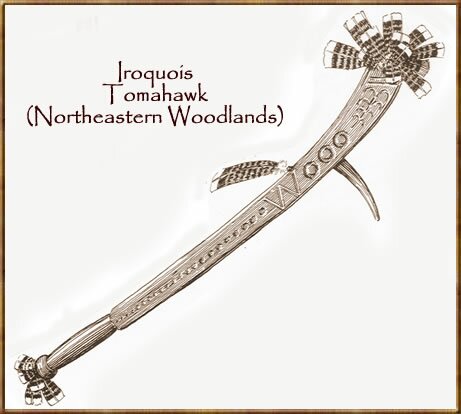
What were Iroquois weapons and tools like in the past? Iroquois war club | Iroquois hunters used bows and arrows. Iroquois fishermen generally used spears and fishing poles. In war, Iroquois men used their bows and arrows or fought with clubs, spears and shields. Here is a website with pictures and information about Iroquois Indian weapons. Other important tools used by the Iroquois Indians included stone adzes (hand axes for woodworking), flint knives for skinning animals, and wooden hoes for farming. The Iroquois were skilled woodworkers, steaming wood so they could bend it into curved tools. Some Iroquois people still make lacrosse sticks this way today. |
What are Iroquois arts and crafts like?  Iroquois beadwork | The Iroquois tribes were known for their mask carving. Iroquois masks are considered such a sacred art form that outsiders are still not permitted to view many of them. Native beadwork and the more demanding porcupine quillwork are more common Iroquois crafts. The Iroquois Indians also crafted wampum out of white and purple shell beads. Wampum beads were traded as a kind of currency, but they were more culturally important as an art material. The designs and symbols on Iroquois wampum belts often told a story or represented a person's family. http://www.bigorrin.org/iroquois_kids.htm |
Monday, June 17, 2019
Navajo Tribe
How do you pronounce the word "Navajo"? What does it mean?Navajo is pronounced "NAH-vuh-ho." This spelling came from Spanish-- you can sometimes see the same name spelled "Navaho" instead. It comes from a Pueblo Indian word for "planted fields" or "farmlands." The Pueblo Indians probably gave them this name because unlike their relatives the Apaches, the Navajos were farmers who lived in settled villages. Traditionally the Navajos called themselves Dine'é or just Diné (which means "the people"), but today most Navajo people also use the word "Navajo" themselves, especially when they are speaking English. Where do the Navajos live?The Navajo are natives of the Four Corners region (Arizona, New Mexico, Utah, and Colorado). The Navajo people are still living in their traditional territory today. How is the Navajo Indian nation organized?The Navajos live on a reservation, which is land that belongs to them and is under their control. The Navajo Nation has its own government, laws, police, and services, just like a small country. However, the Navajos are also US citizens and must obey American law. In the past, each Navajo band was led by its own chief, who was chosen by a tribal council. Most important decisions were made by the council, and all the Navajo councilmembers had to agree before an action could be taken. A Navajo chief was more like a tribal chairman than a king. Most of his job was mediating between the other Navajos. Today, the Navajo Nation is led by a president and tribal council that are elected by all the people.
What language do the Navajo Indians speak?Almost all Navajo people speak English today, but nearly 150,000 Navajos also speak their native Navajo language. Navajo is a complex language with tones and many different vowel sounds. Most English speakers find it very difficult to pronounce. If you'd like to know an easy Navajo word, "yá'át'ééh" (sounds a little like yah-ah-t-ay) means "hello" in Navajo. How do Navajo Indian children live, and what did they do in the past?They do the same things all children do--play with each other, go to school and help around the house. Many Navajo children like to go hunting and fishing with their fathers. In the past, Indian kids had more chores and less time to play in their daily lives, just like colonial children. But they did have dolls, toys, and games to play. Navajo children liked to run footraces, play archery games, and ride horses. A Navajo mother traditionally carried a young child in a cradleboard on her backs.  What were men and women's roles in the Navajo tribe?Men and women did different jobs in Navajo society. Navajo men were hunters, warriors and political leaders. Only men were chiefs in the Navajo tribe. Navajo women were farmers, tended livestock, and also did most of the child care and cooking. Even artwork was separated by gender. Men made jewelry, and women wove rugs and sculpted clay pots. Both genders did take part in storytelling, music, and traditional medicine.
 Today, many of these gender roles have changed. Navajo men are often farmers and ranchers now... and Navajo women join the Army.
What were Navajo homes like in the past?Navajo people lived in hogans, which are traditional earth houses. A hogan is made of a special wood framework packed with clay into a domed shape, with the door facing east. The thick earthen walls insulate the hogan and protect the people inside from wind and strong weather.
 What were Navajo clothes like? Did the Navajos wear feather headdresses and face paint?Originally, Navajo men wore breechcloths and the women wore skirts made of woven yucca fiber. Shirts were not necessary in Navajo culture, but both men and women wore deerskin ponchos or cloaks of rabbit fur in cool weather, and moccasins on their feet. After sheep were introduced and Navajo women could weave larger woolen items, men began to wear poncho-style wool shirts, women began to wear wool dresses with shoulder straps, and heavy wool blankets began to replace fur cloaks. In the late 1800's and early 1900's, long velveteen shirts and blouses came into fashion and Mexican-style full cotton skirts became popular with Navajo women. These styles are still popular today.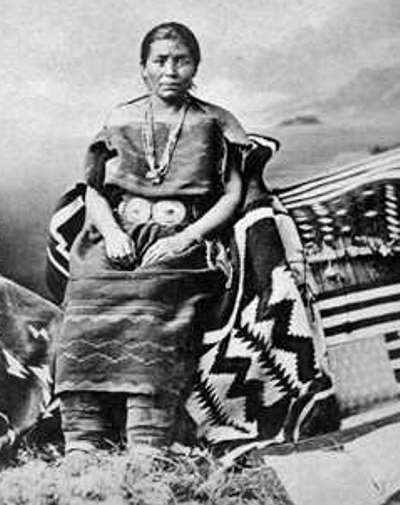
The Navajos did not traditionally wear Indian headdresses. Navajo men usually wore cloth headbands tied around their foreheads instead. Both men and women wore their hair gathered into a figure-eight shaped bun called a tsiyeel, though some Navajo men did begin cutting their hair to shoulder-length in the Pueblo style during the early 1900's. Except for certain religious ceremonies, the Navajos didn't paint their faces or bodies. But they are famous for their beautiful silver and turquoise ornaments, particularly concha belts (made of interconnected silver medallions), brooches, and jewelry.
What was Navajo transportation like in the days before cars? Did they paddle canoes?No--the Navajo Indians weren't coastal people, and rarely traveled by river. Originally they just walked. There were no horses in North America until colonists brought them over from Europe, so the Navajos used dogs pulling travois (a kind of drag sled) to help them carry their belongings. Once Europeans brought horses to America, the Navajos could travel more quickly than before. What was Navajo food like in the days before supermarkets?The Navajos were farming people. They raised crops of corn, beans, and squash. Navajo men also hunted deer, antelope, and small game, while women gathered nuts, fruits, and herbs. After the Spanish introduced domestic sheep and goats, the Navajos began raising herds of these animals for their meat and wool as well. What were Navajo weapons and tools like in the past?Navajo hunters used bows and arrows. In war, Navajo men fired their bows or fought with spears and rawhide shields. Navajo tools included wooden hoes and rakes for farming, spindles and looms for weaving, and pump drills for boring holes in turquoise and other beads.What are Navajo arts and crafts like?Navajo artists are famous for their colorful woven rugs and silver and turquoise jewelry. They also made pottery, baskets, and sandpaintings. Here is a good site on the history of Navajo rug weaving. What about Navajo religion?Sorry, but we cannot help you with religious information. Religions are too complicated and culturally sensitive to describe appropriately in only a few simple sentences, and we strongly want to avoid misleading anybody. You can visit this site to learn more about the Navajo religion or this site about Native American religions in general. Natural Resources:
- Animals: The desert animals were reptiles and snakes. Livestock included sheep and goats and wild turkey
- Crops: The crops grown in the area were corn, beans, sunflower seeds and squash
http://www.bigorrin.org/navajo_kids.htm
https://www.warpaths2peacepipes.com/indian-tribes/navajo-tribe.htm
Subscribe to:
Posts (Atom)

-
Where do the Sioux people live? The original Lakota/Dakota homelands were in what is now Wisconsin , Minnesota , and North and South Da...
-
How do you pronounce the word "Navajo"? What does it mean? Navajo is pronounced "NAH-vuh-ho." This spelling came from S...
-
How do you pronounce the word "Apache"? What does it mean? Apache is pronounced "uh-PAH-chee." It means "enemy...